8 min reading time · Sortimo Station Essen
Which van racking suits which van?
From the Caddy to the Crafter: what the vehicle class decides about the right racking — and what to watch out for at each size.
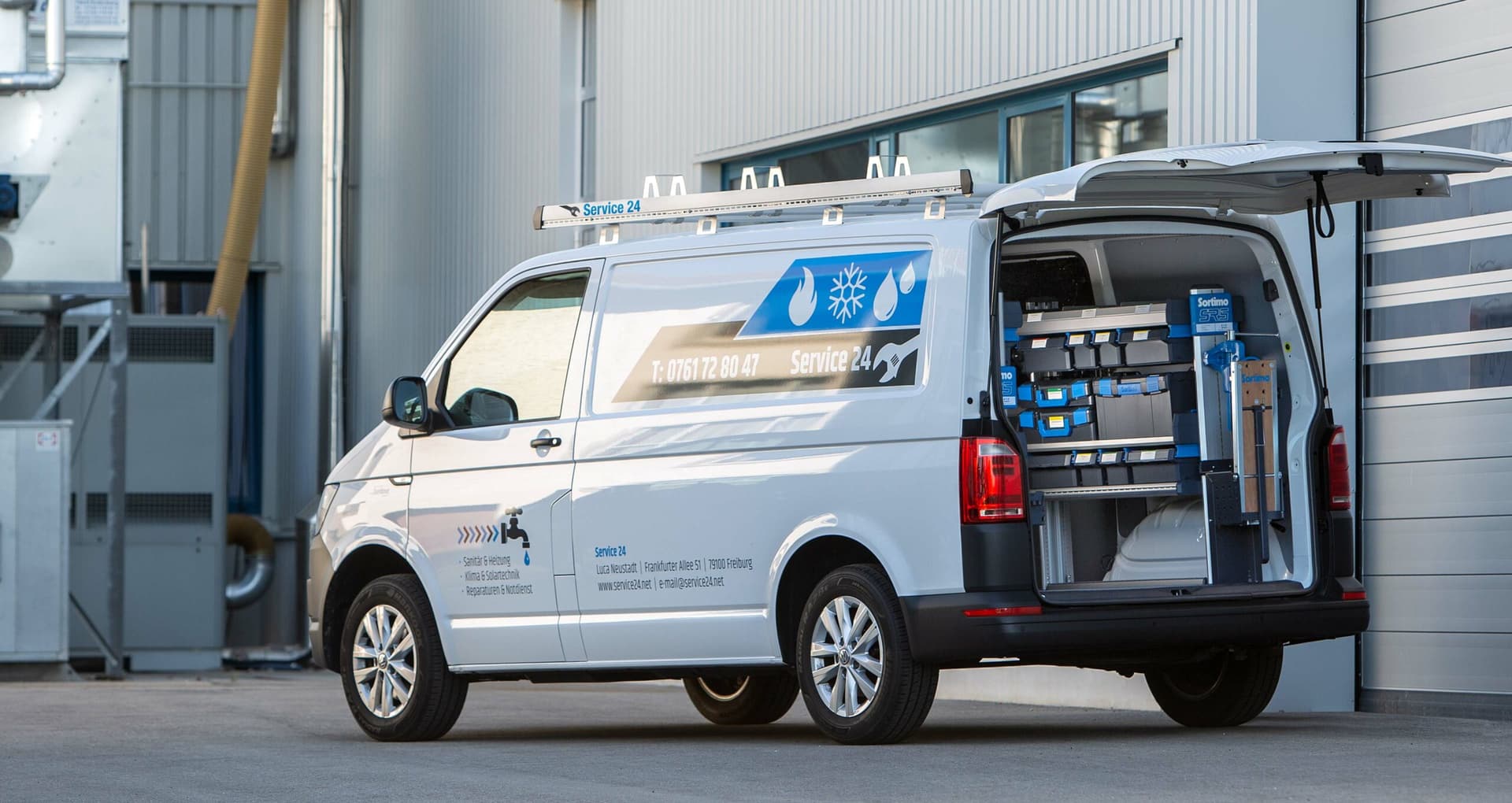
Three details decide the racking
Which racking fits your vehicle follows from three details: vehicle class, wheelbase and roof height. All three are in the registration document or in the model designation — and without them, anything said about compartments, shelf metres and pull-outs is speculation.
The vehicle class determines the width of the load space and therefore whether two-sided racking makes any sense at all. The wheelbase determines the usable length and therefore the number of shelf metres. The roof height determines how many shelf levels can sit above one another and whether you can stand up in the load space.
The payload comes on top as a fourth quantity — it does not limit the space but what you are allowed to put in it. In the compact class and in electric vehicles in particular, it is the real bottleneck rather than the volume.
Understanding wheelbase and roof height: L1 to L4, H1 to H3
The L and H codes are the most compact description of a van — L stands for the length via the wheelbase, H for the roof height. The actual dimensions differ between manufacturers, but the logic is the same everywhere: the higher the number, the more load space.
L1 denotes the short wheelbase, L2 the medium, L3 the long and L4 the rear-overhang-extended body, which not every model offers. In practice each step up means additional load space length — and with it room for another section of shelving or a longer long-goods tray.
H1 is the standard roof, H2 the high roof, H3 the super-high roof. The jump from H1 to H2 is the most important: only then can a second shelf level above the wheelhouse be used sensibly in many vehicles, and you can stand largely upright in the load space. That noticeably changes how you work at the vehicle.
Bear two side effects of a high roof in mind: headroom in multi-storey and underground car parks becomes an issue, and the centre of gravity rises. Anyone regularly working in city centres often chooses H1 deliberately, with more densely packed racking, rather than H2 with more air.
| Class | Typical models | Wheelbase | Roof height | Recommended racking |
|---|---|---|---|---|
| Compact | VW Caddy, Renault Kangoo, Peugeot Partner, Ford Transit Connect | L1 to L2 | H1 | Single-sided, shallow, drawers for small parts, few case holders |
| Mid | VW Transporter, Mercedes Vito, Ford Transit Custom, Renault Trafic | L1 to L2 | H1, sometimes H2 | One side fully fitted, second side half height for long goods |
| Large | VW Crafter, Mercedes Sprinter, Fiat Ducato, Ford Transit | L2 to L4 | H1 to H3 | Both sides with a zoning concept, work bench, second level on high-roof versions |
| Dropside | Sprinter dropside, Ducato dropside, Crafter dropside | L2 to L4 | not applicable | Underbody boxes, tool cases, load securing on the bed |
| Crew van and car-derived | Crew vans and high-roof crew vans with a seat row | short | low | Compact rear module behind the seat row, emphasis on BOXXes |
Compact class (Caddy, Kangoo, Partner)
In a compact city van every centimetre counts. What works well is single-sided, shallow racking with small-part drawers and a few case holders — the second side stays free for bulky items. Important: watch the low permissible gross weight; here lightweight construction is not an option but a must.
The typical layout: narrow shelving on the driver's side with shallow drawers for small parts and hand tools, with one or two shelves above. The passenger side stays clear or gets only a low barrier so that material can be loaded across the vehicle.
One detail that is often overlooked in this class: the load sill height and the door apertures. The sliding door is narrow, the rear opening low — modules have to be planned so that they can be got in at all and the doors stay clear. The spare wheel or puncture repair kit under the floor also needs to stay accessible.
The payload in this class is considerably lower than in its larger siblings. Calculate especially carefully here: driver, passenger, racking and tools add up quickly, and what is left is often not enough for heavy material. If you regularly carry packaged goods, the mid class serves you better.
Mid class (Transporter, Vito, Custom)
The best-selling class offers room for full racking on both sides — but does not have to use it. Typical: driver's side fully fitted with shelving and drawers, passenger side half height so that long materials can lie across. Here it is the stocktake that decides, not the space.
This class is so popular because it offers the best balance: it still drives like a car, fits most underground car parks and still carries serious racking. For the great majority of trade businesses it is the right choice.
On wheelbase it is worth looking at the long body. The price difference is modest, and the gain in load space length often amounts to a complete additional section of shelving. If you are torn between L1 and L2 and carry long goods, take L2.
On the roof the picture is more nuanced. Many models in this class are available with a high roof, but headroom then becomes a daily issue. Anyone working mostly in towns and residential areas usually stays with H1 and makes better use of the height inside the shelving.
Large class (Crafter, Sprinter, Ducato)
In a large panel van the racking becomes a mobile workshop: work bench modules, a vice, long-goods trays and a well-considered zoning concept — small parts and tools at the front, machines and material at the back. On high-roof versions a second shelf level is worthwhile.
The difference from the mid class is less about space than about planning depth. Where the layout almost follows by itself in a smaller vehicle, here you need a concept — otherwise you end up with a large load space with a lot of empty middle and material that still is not within reach.
A three-zone split has proven itself: at the front by the bulkhead, the small parts and hand tools needed daily in drawers; in the middle, the case holders and the work surface; at the back by the rear doors, the heavy machines and the material that is loaded with a pallet truck or by two people.
On L3 and L4 with a high roof there is one further point that is often underestimated: reach. Shelving whose top compartment nobody can get to is dead volume. Plan the upper level for light and rarely used items — and reckon on a step.
Special cases: dropside, crew van and double cab
Dropside vehicles work with underbody boxes and tool cases, crew vans with compact rear modules behind the seat row. With electric vans the weight question is even more critical — and the racking must not touch any high-voltage components. There are tested solutions for that too.
Dropside and tipper
With no enclosed load space, the organisation moves underneath the bed: underbody boxes between the chassis and the body take tools and small material, weatherproof and lockable. On the bed itself, load securing with lashing points, stanchions and nets is what counts — there is no bulkhead here to catch anything.
Crew van and high-roof crew van with a seat row
If the second row of seats stays in, the usable space shrinks to the area behind the seats. Compact rear modules with pull-outs and case holders make sense, coupled with a partition to the passenger compartment. The case share is usually higher here, because the vehicle offers little area for classic shelving.
Double cab
A double cab costs load space length and payload at the same time — the second row of seats weighs something, and so do the people on it. The racking is correspondingly more compact and concentrates on the area directly behind the cab. Calculate the payload especially carefully here, because it is quickly taken up by four or five people.
Electric vans: what changes in the planning
With electric vans the racking plan changes in three places: payload, high-voltage components and weight distribution. The space in the load area is usually the same as in a combustion model — the weight budget is not.
The most important point is the payload. The battery pack brings considerable weight that comes straight off the available allowance. In electric vehicles lightweight construction is therefore not an option but the only way to retain any sensible payload at all. Systems such as SR5 are often the precondition here rather than a luxury.
The second point concerns installation. In many models the battery, cabling and control units sit in the underbody or beneath the load floor. Drilling as you go is not permitted, and the designated mounting points have to be observed. An improvised installation here is not just a warranty question but a genuine safety risk.
The third point is range. Every extra kilogram of racking costs range — more in winter than in summer. If your calculation is tight, keep the racking on the lean side and increase the case share: material that only travels when the job needs it does not weigh on the balance permanently.
Before you buy the vehicle: factor the racking in
The best time to think about the racking is before ordering the vehicle — not afterwards. Buy the vehicle first and then find that the wheelbase or payload does not match your material requirement, and you are correcting a mistake that is fixed for years.
Three decisions at purchase have a direct effect on the racking. The wheelbase determines how many shelf metres you get — saving here is the decision most often regretted. The payload variant determines how much material you may legally carry. And the number of sliding doors determines whether one side of the vehicle can be fully fitted out at all.
Details that look harmless in the configurator matter too: a second row of seats costs load space and payload, wooden lining in the load space costs centimetres of width, and a bulkhead with a window reduces the bearing surface available for positive locking.
So bring the vehicle configuration to the consultation before you order. Half an hour of cross-checking shows whether the intended vehicle matches how you work — and whether a size up or a longer wheelbase would be the better decision.