Industry solution · Plumbing · Heating · Air conditioning
Van racking for plumbing and heating companies
Heavy tools, fittings in every dimension and emergency call-outs under time pressure: plumbing and heating vehicles have to be store, workshop and spare parts stock all at once.
Lightweight
SR5 creates payload reserves for heavy equipment
10 pm
ready for emergency service: every reach works at night, too
3rd generation
many plumbing and heating companies are on their third vehicle with us
From everyday work
Typical challenges
Weight
Press machines, pipe wrenches and material add up quickly — payload gets tight.
Fittings & seals
Dozens of dimensions and variants have to be sorted and found fast.
Emergency service
On a 10 pm call-out every reach counts — the racking has to work at night, too.
Proven in Plumbing · Heating · Air conditioning
Our recommendation
SR5 lightweight construction creates payload reserves. Drawers with tray inserts sort fittings by dimension, heavy machines travel low down in deep trays. A proven approach for emergency service: one permanently stocked 'breakdown BOXX' holding the material for the most common call-outs — grab it and go.
Discuss the recommendation
How it can look
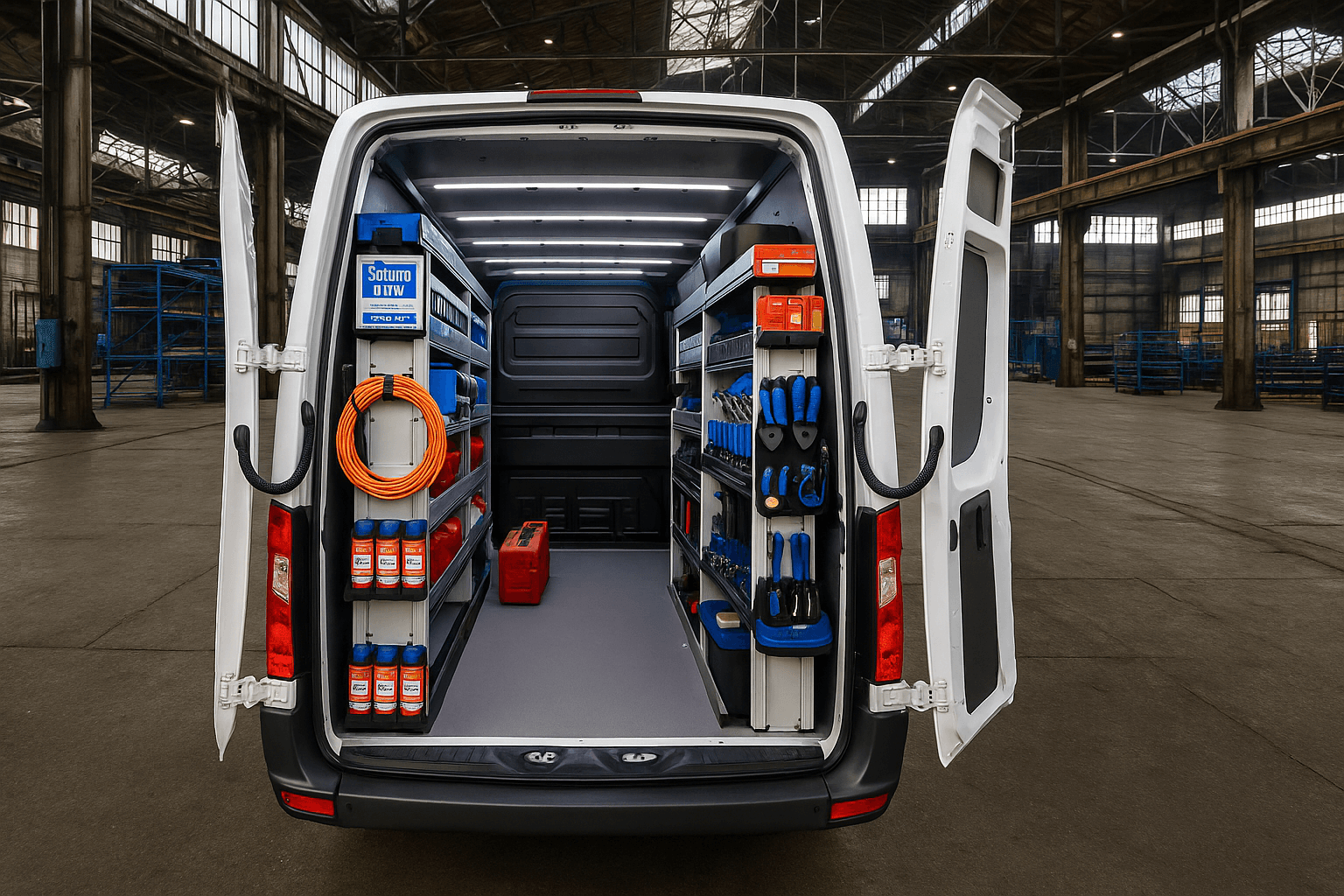
Typical build: Sprinter for heating installation and service
Floor zone
Heavy-duty trays for press machine and welding set — low down for back-friendly removal.
Drawers
Fittings and seals in tray inserts sorted by dimension — found at a glance.
Bulkhead
Gas bottle holder with securing chain, next to it the breakdown BOXX for the most common call-outs.
Roof
Long pipe material in the lockable roof tray.
Plumbing and heating has been one of our strongest trades for decades — many companies are already having their third generation of vehicles fitted out by us.
By company size
Which setup suits your business?
One-man business
Anyone working alone needs an honest weight calculation above all. A press machine, cordless tools and a basic stock of fittings use up the payload of a medium panel van faster than expected. Lightweight shelving on one side, heavy-duty trays low down and a permanently stocked breakdown BOXX cover everyday work between maintenance and emergency call-outs.
Small company, 2 to 10 vehicles
This is usually where the roles separate: one or two service vehicles with a dense stock of fittings, plus vehicles for bathroom and heating installation with more open area for sanitaryware and pipe material. We still keep the drawer division uniform, so material can be swapped between vehicles.
Fleet of ten vehicles or more
In larger companies a documented standard pays off, especially for emergency service. If every breakdown BOXX is stocked identically, any fitter can take over any vehicle. We record the layout and contents in writing and build new vehicles to match, even when months lie between two batches.
Tools & material
What goes where
| Item | Where it goes |
|---|---|
| Cordless press machine with press jaws | The machine low down in a heavy-duty tray, the jaw sets in a shallow drawer directly above. The two stay together and the centre of gravity stays low. |
| Fittings, press connectors, adaptors | Drawers with tray inserts, one dimension per tray. The order follows the dimension, not chance — so you reach for the right one at night, too. |
| Seals, O-rings, hemp and jointing compounds | An i-BOXX with Insetboxes for the small parts, jointing compounds separately in a tray with a collecting rim. Liquids never belong in the same drawer as seals. |
| Pipe wrenches, pipe cutters, deburrers | Tool panel or drawer with holders at hand height. Heavy wrenches lie flat rather than on edge, so they do not wander under braking. |
| Gas bottle for soldering and brazing | Tested holder with securing chain on the bulkhead or side wall, with the required labelling on the vehicle and ventilation of the load space. |
| Core drill and core bits | The machine in the heavy-duty tray, the bits in their own compartment with dividers. Wet bits go into an area that can be hosed out, not into the closed shelving. |
| Pipe material and long goods | Lockable roof tray or a long-goods tube under the load space ceiling. The floor stays free for radiators, cylinders and sanitaryware. |
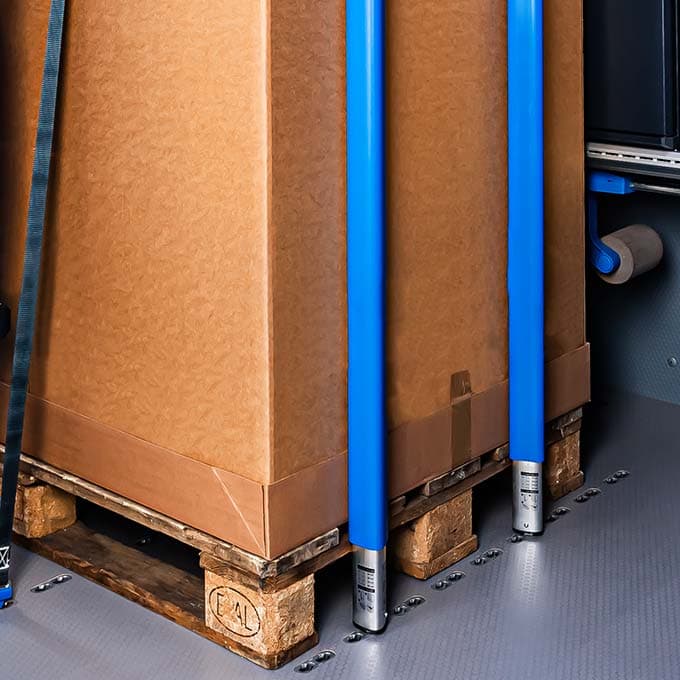
| Radiators and sanitaryware | An area kept clear with lashing rails, tensioning bars and blankets. Items travel upright and form-fit, so no rub marks develop. |
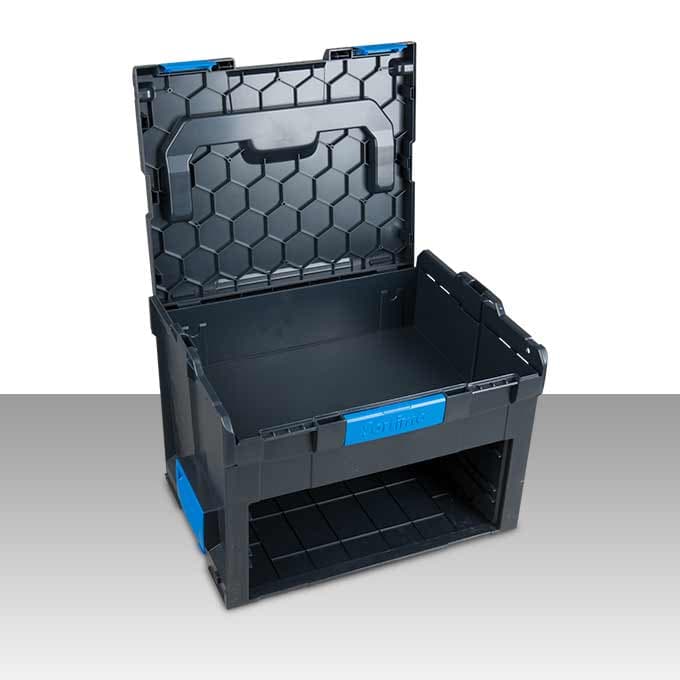
| Breakdown BOXX for emergency service | A permanently stocked L-BOXX in a defined position: isolating material, hose clamps, pipe couplings, seals and basic tools. Grab it and drive off. |
| Mobile workstation for basement jobs | WorkMo with worktop and vice, strapped to lashing rails. It replaces working on the basement floor or on the customer's washing machine. |
From practice
Typical planning mistakes
A full build without a weight calculation
Plumbing and heating is the trade where payload most often becomes the problem. Press machine, core drill, stock of fittings and pipe material together add up to more than the registration document allows — if the shelving has already used up a substantial share.
Heavy equipment at mid shelf height
Press machines and drilling equipment belong at the bottom. At hip height they cost your back, raise the centre of gravity and are the largest mass in the load space under emergency braking.
Liquids next to the tools
Jointing compounds, soldering fluid and cleaners leak sooner or later. Without a tray with a collecting rim they ruin the drawer and, at worst, half the stock of fittings underneath.
Emergency service contents left undefined
Anyone who has to work out at night what needs to come along drives out twice. A clearly defined and regularly checked emergency stock is the simplest lever for shorter call-out times.
Vehicle choice
Suitable vehicles for this trade
High-roof crew van
Typical models
VW Caddy Cargo, Renault Kangoo, Citroën Berlingo, Ford Transit Connect
Suitability
Usable for maintenance and light service work, but quickly at the payload limit with heavy equipment. A press machine plus core drill usually no longer fits in weight terms.
Medium panel van
Typical models
VW Transporter, Ford Transit Custom, Mercedes Vito, Renault Trafic
Suitability
A good compromise for classic plumbing and heating service work. Heavy-duty trays below, fitting drawers above, a roof tray for pipe — usually as much as the payload allows.
Large panel van
Typical models
Mercedes Sprinter, VW Crafter, Ford Transit, MAN TGE
Suitability
The typical choice for heating installation and bathroom fitting. Standing height, payload reserve for cylinders and radiators, space for a gas bottle holder and a mobile workstation.
Dropside or box body
Typical models
Sprinter dropside, Iveco Daily, Ford Transit chassis
Suitability
Sensible if boilers, cylinders or old parts are transported regularly. Tools travel in lockable underfloor boxes and the load bed stays clear.
Further reading
Payload is the hardest constraint in plumbing and heating
In hardly any other trade does the payload sit so close to the limit. A cordless press machine with jaw sets, a core drill, a set of pipe wrenches and an average stock of fittings already weigh a considerable amount together — before any material for the job has been loaded at all. Add a heavy full build and the permissible gross weight is quickly exceeded when fully loaded.
That is why every plumbing and heating project with us starts with a calculation rather than a shelving proposal: kerb weight from the registration document, the weight of the planned build, typical tool and material load. Only once that total works do we talk about shelves and drawers. In many cases this leads to a deliberately leaner build — with more open area and flexible securing instead of extra metres of shelving.
The second lever is distribution. Heavy equipment belongs low down and, as far as possible, between the axles. That lowers the centre of gravity, relieves the rear axle and makes the vehicle far more predictable when fully loaded.
Emergency service determines the layout
A plumbing and heating vehicle is used differently during the day than at 10 pm. In daylight you have time to search the shelving; with a burst pipe, what counts is that the first reach is right. That is exactly what the breakdown BOXX has proven itself for: a permanently stocked L-BOXX in a defined position holding everything for the most common emergencies — isolating material, hose clamps, pipe couplings, seals and a set of tools.
We derive the contents together from your call-out statistics. Which five cases make up the bulk of your night work? What was missing last time? A BOXX defined from practice is clearly superior to a general recommendation.
In addition, we plan load space lighting more generously than would be necessary in daylight. Reaching into an unlit load space in the dark costs time and hides missing stock.
Plan for dirt from basements and boiler rooms
Plumbing and heating vehicles get dirtier than most other trade vehicles. Wet offcuts of pipe, heating water, mud from the basement shaft and dust from core drilling inevitably end up in the load space. Racking that does not allow for this looks the part after a year.
A clear zone separation has proven itself: coated, washable floor panels and open trays for everything that comes back wet and dirty, closed drawers for fittings, seals and cordless equipment. What matters is that the dirty zone is generously sized — otherwise the wet equipment ends up back in the clean area after all.
Frequently asked questions from Plumbing · Heating · Air conditioning
Advice for Plumbing · Heating · Air conditioning
Tell us about your vehicle and your working day — we will plan the conversion that suits your trade.
Also of interest