9 min reading time · Sortimo Station Essen
Load securing in a van: what you need to know
Why unsecured loads are so dangerous, what the law requires and which securing methods have proven themselves in day-to-day trade work.
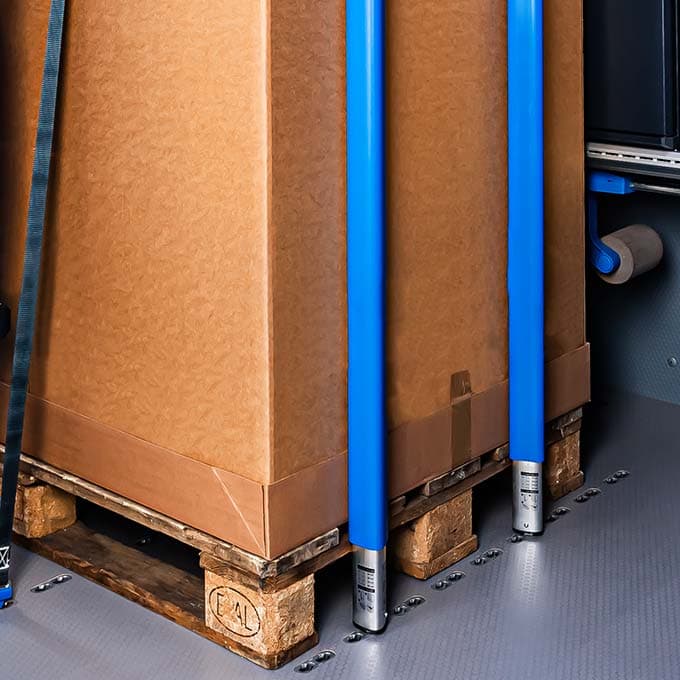
Why load securing is not a nice-to-have
An unsecured load is the most common avoidable hazard in a van — because it never draws attention in normal running and becomes a problem at exactly the moment something else is already going wrong. In a full-brake stop from 50 kph, the forces acting on the load reach a multiple of its own weight. A 20-kilo tool case becomes a projectile with several hundred kilograms of impact force — towards the bulkhead and, in the worst case, towards the driver's cab.
Then there is the legal side: Section 22 of the German Road Traffic Regulations (StVO) requires loads to be stowed and secured so that they cannot slip or fall even under emergency braking or an evasive manoeuvre. Driver and vehicle keeper are jointly responsible — with company vehicles, that includes the business itself.
In practice this means the responsibility cannot simply be passed down to the fitter. Anyone who runs vehicles has to make sure that securing the load is possible in the first place — with lashing points, a bulkhead and racking that holds the material in place. An empty load space with no anchorage at all makes correct securing practically impossible.
The second reason is economic and often underestimated: a load that slides gets damaged. Measuring instruments, cordless machines and tiles rarely survive an unbraked trip through the load space intact. Stow your tools by positive locking and you save on replacements — and you find them again in the morning exactly where you put them.
Which forces actually act on the load
The load is not only stressed under braking but in every direction — and that is exactly what gets overlooked in practice. The strongest force acts forwards, because emergency braking produces the highest deceleration. Sideways forces occur when you swerve or take a bend at speed, rearward forces when you pull away or reverse into a kerb.
That explains why securing that is only thought through in the forward direction is not enough when it matters. A stack of material pushed up against the bulkhead is well held forwards — but it topples sideways in an evasive manoeuvre if there is nothing to contain it. This is why planned racking works with enclosed compartments instead of open surfaces.
On top of that come vertical components: potholes and kerbs briefly unload the cargo, and friction against the load floor drops almost to zero at that instant. Purely friction-based securing, which relies on friction alone, loses its effect at precisely that moment. Positive-locking elements, by contrast, keep working.
The two basic principles: positive locking and friction locking
Every form of load securing rests on one of two principles — or on a combination of both. Once you know the difference, you make faster and better decisions day to day.
Positive locking: the load cannot move
Positive locking means the load sits flush against something — the front wall, dividers, a drawer, or between load bars. It cannot start moving because it has nowhere to go. This is the fastest method in daily use, because no strap has to be tensioned and nothing can work loose. What matters is that no gaps remain: a few centimetres of play are enough for the load to build momentum and strike with considerably more force.
Friction locking: friction through tie-down lashing
Friction-based securing presses the load onto the load floor with lashing straps and thereby increases the friction between load and surface. It suits bulky individual items that cannot be fitted in by positive locking. What matters here are tested straps to DIN EN 12195-2, adequately dimensioned lashing points and an anti-slip underlay. The drawback: the effect depends on the pre-tensioning force, and that decreases while driving — straps must be checked after the first few kilometres.
Direct lashing as a special case
With direct lashing the load is not pressed down but connected directly to the lashing points by straps run at an angle. This holds machines and heavy individual items reliably in place, but it requires suitable anchorage on the load itself and takes more time. In everyday trade work it is the exception for heavy equipment, not the rule for daily material.
Anti-slip mats: high effect, little effort
An anti-slip mat is the cheapest aid with the biggest effect per euro — because it acts directly on friction. On a smooth wooden or plastic floor, a load starts to slide under even moderate deceleration. An anti-slip mat between load and load floor increases friction considerably and therefore reduces the pre-tensioning force a strap has to apply.
In practical terms: fewer straps for the same securing effect, or the same number of straps with a greater margin. Correct use matters — the mat belongs underneath the load, not next to it, and the contact surface must be clean. Oil, dust and swarf reduce its effect.
What anti-slip mats cannot do is replace securing. They are an amplifier, not a securing device in their own right. A load standing on a mat and nothing else is not secured. Combined with positive locking or lashing, however, they are a tool every fitter uses correctly without any training.
Proven in daily use: leave a cut piece permanently in the vehicle rather than rolling it up after every job. Mats you have to go looking for do not get used. Worn mats with a polished surface should be replaced — by that point their effect is barely there.
Lashing points, rails and bulkhead — the infrastructure
Load securing needs anchorage, and that determines everything that follows. A vehicle with four eyelets in the floor corners can only be secured at four places — which means long straps running at unfavourable angles. Airline lashing rails in the floor and side walls solve the problem, because the anchorage point can be moved freely along the rail.
The bulkhead is the second building block and the most important one for protecting people. It keeps the load away from the driver's cab and at the same time acts as a bearing surface for positive locking towards the front. Where there is no bulkhead, the load space ends at the front seats — with the risk that entails.
Telescopic load bars and load securing nets close the gap for changing loads. A bar tensioned across the load space behind the loaded material turns an open load space into a bounded compartment — positive locking with no conversion work, set up in under a minute.
How to recognise a usable lashing point
A usable lashing point is firmly connected to the vehicle structure — not to a floor panel or a trim piece. It is positioned so that the strap runs at a sensible angle, and it can be reached without climbing over the load. Points you cannot get to do not get used.
Why the racking itself has to be anchored
Racking that secures a load must itself be secured. This is why van racking is bolted to the body mounting points provided by the manufacturer — not simply stood on a wooden board. Racking that works loose is more dangerous than a loose load, because it brings considerably more mass with it.
What works in a trade vehicle
In practice, well-equipped vehicles combine both: van racking secures tools and small parts by positive locking in drawers and case holders. For the open load space, airline lashing rails, telescopic load bars and nets ensure that changing loads are secured in seconds.
The decisive point is the split. Whatever travels every day is stowed properly once and stays there — in drawers with detents, in case holders, in closed compartments. Only the changing share has to be secured afresh each day, and that then takes just a few movements.
BOXXes are a special case here with a double benefit: locked into the racking they sit in positive lock, at the point of use they are the transport container. So you are not securing on top of transporting — you are securing through the way you transport, which is why case-based solutions perform so well in load securing.
Our tip from more than 37,000 fitted-out vehicles: plan load securing together with the racking — retrofitting lashing points is possible, but the integrated solution is cleaner and often cheaper.
Typical mistakes from workshop practice
Most securing shortcomings arise not from ignorance but from time pressure — and they can be designed out through the racking itself. These are the six mistakes we see most often on existing vehicles.
| Mistake | Why it is a problem | How to fix it |
|---|---|---|
| Load stacked loose against the bulkhead | Supported forwards, completely free sideways — topples when you swerve | Lateral containment by racking, load bar or net |
| Strap run over sharp edges | The strap is damaged and tears at exactly the moment it is loaded | Use edge protectors or move the anchorage point |
| Heavy machines loaded right at the back | Worsens axle load distribution and handling | Heavy items forward and low down, ideally over the rear axle |
| Gaps between load and bearing surface | The load builds momentum and strikes with a multiple of the force | Fill the gaps or close them up with a load bar |
| Small parts in open boxes | The contents scatter at the first hard braking | Closed drawers or locked BOXXes |
| Straps not re-tensioned after loading | Pre-tensioning force drops off over the first few kilometres | Check once after a short stretch of driving |
Building load securing into the daily routine
Load securing only works if doing it is quicker than thinking about it — anything else gets dropped under time pressure. The most important organisational measure is therefore to reduce the effort per trip to a few movements. Fixed places are how you get there: every item has its spot, and that spot already secures it.
A quick look before setting off is then enough as a check: are all the drawers shut, all the BOXXes locked, is the changing share strapped down? Businesses that make this look a habit have noticeably less damage in the load space — and a vehicle that still looks tidy after two years.
A short briefing pays off for your staff. When we hand over a fitted-out vehicle we explain where the lashing points are, how load bars are set correctly and what the racking already covers. It takes a quarter of an hour and answers the questions that otherwise stay open for months.
If you are unsure whether your current vehicle can be sensibly secured, bring it in loaded. In 33 years of Sortimo Station Essen we have seen few load spaces where noticeably more safety could not be achieved with manageable effort.