9 min reading time · Sortimo Station Essen
The mobile workshop: working professionally without a work bench
How installation teams set up a full workstation on site — in minutes, without improvising.
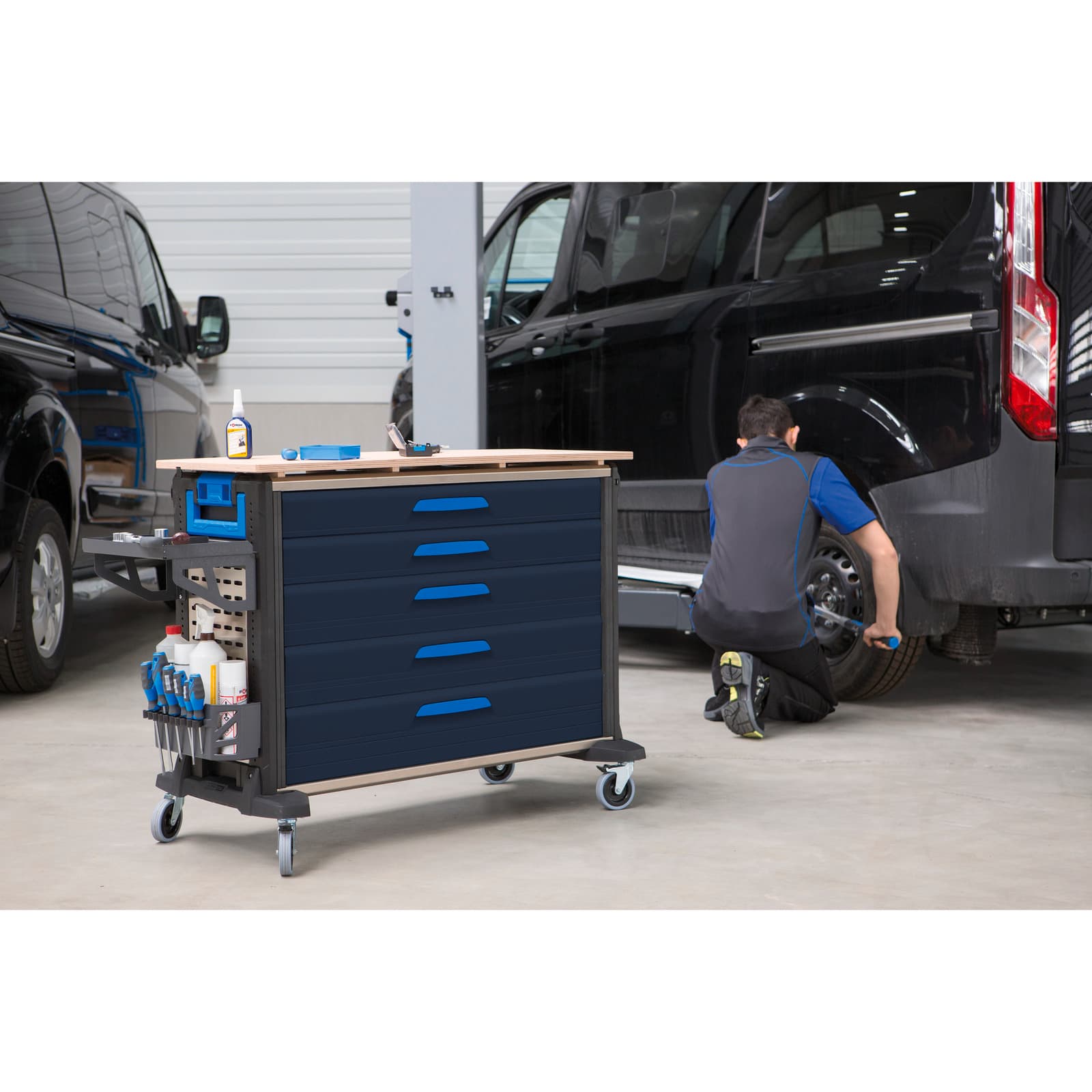
The problem: working on the floor
On installation sites what the workshop takes for granted is almost always missing: a work bench at working height, a vice, sorted material within reach. The result is kneeling work, tools scattered about — and, at the end of the day, a back that pays for the improvisation.
Then there is the loss of quality. A workpiece lying on an upturned bucket or a pallet cannot be clamped properly. What takes two minutes in the workshop becomes a test of patience on site — and may well have to be reworked.
The third point is lost material. Small parts lying on a bare floor disappear reliably: into screed residue, under insulation boards, into the rubble. Across a project that adds up to a cost item nobody budgets for, because it never appears on an invoice.
And finally there is how you come across to the customer. In occupied buildings, in kitchens or in consulting rooms, the difference between a properly set-up workstation and dust sheets spread over the floor is what the customer tells other people about later.
The solution: the workstation travels with you
Mobile workstations such as WorkMo bring the fitted-out workstation to the point of use: a mobile base module, a sturdy worktop, an optional vice, drawers underneath and docked BOXXes with material. In the vehicle the station is lashed down; on site it is ready to work in a few minutes.
It pays off quickly, especially for joiners, kitchen and window fitters and plumbing and heating teams: fewer trips back to the vehicle, ergonomic working and a professional impression at the customer's premises.
The conceptual difference from a tool case matters: a case transports material, a mobile station transports the workstation. Alongside the material it brings the surface, the height, the clamping capability and, depending on version, the power supply — precisely what is missing on site.
In the vehicle the station is not a foreign body but part of the racking. It is secured via lashing points or its own mounting, and it docks to the same case holders the shelving uses. That way no second stock of material appears — the BOXXes move between shelving and station.
The four building blocks of a mobile workshop
A mobile workshop that works consists of four elements that have to play together — leave one out and you are improvising again.
1. A work surface at the right height
The worktop is the core. It has to be stable enough for sawing, drilling and clamping, and at a height that lets you work standing up without bending your back. A surface that is too low is barely better than the floor. Stability on uneven ground matters too — on a bare construction floor, nothing stands level.
2. Something to clamp with
Without a way to clamp, the work surface stays a shelf. A vice or clamping device turns it into a workstation: workpieces can be fixed, both hands stay free, and the work comes out cleaner and safer. For installation work a compact vice that can be removed when not needed is often enough.
3. Material within reach
Under the work surface belongs the material that matches the job: drawers for hand tools and small parts, docked BOXXes for fittings and fixings. The requirement is simple — whatever is needed during the work has to be reachable without taking a step.
4. Power at the point of use
Without power the machines stand still. Depending on how you work, the energy comes from the cordless system, from an inverter in the vehicle or from the site power connection. What matters is that the solution is settled in advance and not improvised on the day.
Power supply: what suits which job
The power question determines how independently you can work on site — and in planning it is the question asked too late most often. Three routes are available, and in practice two of them are usually combined.
The cordless system is the standard for hand-held machines and covers a large part of installation work. What matters is not the number of machines but the number of charged batteries and the question of where charging happens. A charging station in the vehicle that works while you drive solves the problem at the root — provided the vehicle's electrics can support it.
An inverter in the vehicle powers mains equipment where there is no site supply. Here the actual power requirement has to be assessed honestly: machine start-up currents are considerably higher than continuous output, and an under-dimensioned system cuts out at exactly the moment it is needed. An auxiliary battery with a split charge relay stops the starter battery from being drained.
A site power connection is the simplest solution where it is available — usually in new build, often not in existing or occupied buildings. If you encounter both, plan for the less favourable case and take a sufficiently long, properly wound cable drum.
| Power source | Suitable for | Limit | Things to consider |
|---|---|---|---|
| Cordless system | Hand-held machines, drilling, driving screws, sawing | Continuous use of high-power equipment | Charging point in the vehicle, number of spare batteries |
| Inverter in the vehicle | Mains equipment without a site supply, chargers | High start-up currents, longer full-load operation | Auxiliary battery with split charge relay, cable cross-section |
| Site power | Stationary machines, continuous operation | Not available everywhere | Cable length, fusing, RCD protection |
| Cordless plus inverter combined | Mixed installation work in existing and new buildings | Additional weight in the vehicle | Recalculate the payload, define the charging routine |
Ergonomics: why working height is not a comfort issue
Working height is where health and economics meet — hours of kneeling and stooping is the most common avoidable strain factor on installation work. Anyone crouched over a workpiece on the floor all day works more slowly, less accurately and with considerably more strain on back and knees.
The effect does not show on the first day but over years. Absence through back problems is a real cost factor in installation trades, and it usually hits the experienced people — precisely those who are hardest to replace.
Alongside height, the lighting matters. A lot of site work happens in half darkness because the lighting is not in yet. A work lamp on the station costs little and improves both quality and safety immediately — particularly with rotating tools.
The third factor is order while you work. Hunting for a tool interrupts the flow and creates stress. A station where every item goes back to its place as you put it down keeps the work moving — and at the end of the job nothing is missing.
Time saved: where it actually comes from
The time gain from a mobile workshop mostly comes not from the workpiece but from the walking and ancillary time around it. That is why the investment pays off even when the actual work takes just as long.
Work through a typical job once: how often does a fitter walk back to the vehicle in a day? How long does one trip through the stairwell take? On a job on an upper floor, five minutes per trip is quickly reached, and six to eight trips a day are not unusual. That is a good half hour that cannot be billed.
Then there is set-up time. A workstation improvised from trestles, boards and clamps costs time to build in the morning and to dismantle in the evening — and it is not identical on the second day. A station is wheeled into place, braked, opened and ready.
The third block is search time. Material that does not come along sorted gets hunted for — in the vehicle, in bags, in boxes. BOXXes loaded for the specific job at the station move that time to the evening before, where it costs considerably less than in the middle of the work.
Examples from consulting practice
What a mobile workshop looks like in concrete terms depends heavily on the trade. Four set-ups we come across regularly in consultations.
Kitchen installation
Two fitters, work in occupied flats, plenty of adjustment work on worktops and panels. The station stands in the flat or in the stairwell, with a worktop, dust extraction and fittings in i-BOXXes. Besides the time, the advantage is the impression it makes: nobody is sawing on the customer's kitchen floor.
Window and door installation
Changing sites, often bare construction, a high share of cutting and adjustment work. Here stability on uneven ground and a way to clamp are what count. The station is set up in one central spot and serves several openings rather than moving with every window.
Plumbing service and heating installation
Cramped plant rooms, plenty of threading work, changing spare parts. The vice is the decisive element here. The station usually stands outside the plant room in the corridor, the material comes along in BOXXes — and the technician no longer walks to the vehicle for every fitting.
Electrical and control panel work on site
Many small parts, fine work, a need for good lighting and a clean surface to work on. The station brings light, surface and sorted terminal material with it. Because much of the work is in existing buildings, the power question is particularly relevant here — the inverter in the vehicle is often the fallback.
From the vehicle to the site and back
A mobile workshop only works if the transition between vehicle and job site is friction-free — that is where improvised solutions fail. Three points decide it.
First, loading. The station has to get into the vehicle over the existing load sill without two people having to lift it. Castors, suitable handles and, if in doubt, a ramp are part of the plan. Anyone who has to lift the station with a colleague every day will eventually leave it behind.
Second, securing it in the vehicle. A station on castors is a considerable mass on the move in the load space if it is not lashed down. It belongs on lashing points or in a mounting provided for it — and the castors are locked as well. This is the point where racking and load securing come together.
Third, loading it up. Pack against the job list the evening before and you start the morning without a single decision to make. Whatever is missing shows up while packing rather than on site. In practice this is the point with the greatest effect — and it costs nothing but discipline.
If you want to check whether this pays off for your business: take a typical job and note down every trip to the vehicle and every minute spent searching over one day. That list is worth more in a consultation than any product description — and it is the basis on which we derive a suitable solution from more than 37,000 fitted-out vehicles.