8 min reading time · Sortimo Station Essen
Organisation systems compared: shelving, BOXX or both?
Fixed shelving, mobile cases or a combination of the two: which organisation strategy suits which working day — an honest comparison.
The decisive question first
Before you compare systems, answer one single question: how far is it from the vehicle to the place of work? Almost the entire decision hangs on that.
If you park right at the job and work out of the open load space, what you mainly need is overview and quick access — which argues for shelving. If you have to carry material through stairwells, across sites or into flats, you need containers that come along for the walk — which argues for cases.
Most businesses sit somewhere in between, and that is exactly why the combination has established itself. The following sections show the strengths and limits of each strategy, and where the dividing line runs in day-to-day work.
Strategy 1: fixed shelving
Classic van shelving with drawers and shelves is the right choice when most of the work happens at or right beside the vehicle — in outdoor facility servicing, for example. Strengths: maximum overview, every part has a fixed place, very good use of space. Weakness: the material stays in the vehicle — if you are working on the fourth floor, you walk.
The big advantage lies in the use of space. Shelving exploits the full height of the load space, works with compartments of differing heights and can be matched to wheelhouses and door apertures down to the last centimetre. No case system reaches the same packing density for a given volume.
The second advantage is the overview. Open shelving shows its own state at a glance — missing material is obvious immediately, and reordering happens in passing. With stacks of closed cases you have to open them first to see what is missing.
The limit is the walk. As soon as material has to be carried, the shelving becomes an interim store: the fitter grabs, gathers an armful, walks, forgets something, walks back. Anyone doing that three or four times a day loses time predictably — and the order in the shelving unravels a little further with every hurried grab.
Shelf, pull-out or drawer?
Shelves with dividers are the cheapest and lightest option and suit material you reach for from the front. Pull-outs make the depth accessible and are worth it wherever something would otherwise disappear at the back of a compartment. Drawers are the best place for small parts and hand tools, because they are enclosed and hold their contents in place even under emergency braking.
Where lightweight construction makes itself felt
Shelving systems such as SR5 Pro and SR5 Max use aluminium and composite construction rather than sheet steel. The weight difference against older steel shelving is considerable and shows up directly where payload is tight — particularly in the compact class and in electric vans, where every kilogram counts.
Strategy 2: the mobile case system
If you have to carry your material to the point of use, you pack it into BOXXes: tools, machines and small parts in stackable, lockable cases. Strengths: you take exactly what the job needs, and the cases are the load securing at the same time. Weakness: without shelving in the vehicle, cases quickly stack up into a mess.
The real gain lies in the preparation. Cases packed for a specific job move the decision about what comes along out of the hectic moment on site and into a quiet minute the evening before. The fitter carries once, not four times — and works there with the same order he would otherwise only have in the vehicle.
The second gain is load securing. A locked BOXX is a closed container whose contents do not scatter under braking. Sitting in a case holder, it is secured by positive locking without a single strap being tensioned.
The limits show with bulky items and bulk material. Pipes, profiles, insulation and packaged goods fit in no case. And a pure case system with no shelving structure means cases stack up in the load space, the bottom one is the one you need, and the day starts with restacking.
L-BOXX: the workhorse case
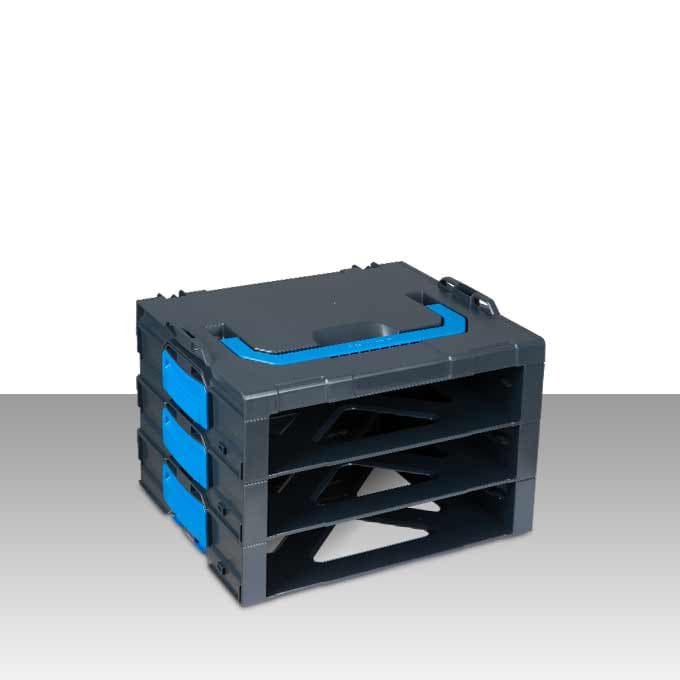
The L-BOXX is the rugged standard case for tools, cordless machines and heavier material. It comes in several heights, it stacks and locks, and it is the size most case holders in the shelving are built around. If you only want to introduce one case family, start here.
i-BOXX: shallow, for small parts
The i-BOXX is the shallow version with inserts for screws, wall plugs, terminals and fixings. It is stacked flat or slid into a rack and can be taken out individually — you take the assortments the job needs rather than the entire small-parts stock.
T-BOXX: sorted stock keeping
The T-BOXX is designed for sorted small material with access through the lid and suits stock keeping where you want to see the contents from above. In practice it is used where the same assortment is needed again and again and refilled regularly.
Why one system beats several brands
The benefit comes from compatibility: cases that lock to one another and fit the same holder in the shelving form a system. A vehicle with four different case formats has four stacks that do not go together — and loses exactly the advantage the cases were bought for.
The practical answer: the combination
In most trades the combination has won through: compact shelving with case holders. In the vehicle every BOXX sits positively locked in the shelving — at the point of use it is taken out, carried, docked back in. That combines the overview of shelving with the mobility of cases, without stocking material twice.
The usual split: one side of the vehicle gets drawers and shelves for the permanent stock — consumables, spare parts, tools that stay in the vehicle. The other side gets case holders for the mobile share. Bulky items and long goods sit low down or in a tray of their own.
The decisive point is that nothing is held twice. Without case holders, many businesses end up with a second set of tools: one in the shelving, one in the cases. That costs money, payload and overview. If the case docks into the shelving there is only one stock — it just sits in a different place depending on the situation.
Decision matrix: which strategy suits you?
The matrix below summarises which strategy comes out ahead on which criterion. It is no substitute for a consultation, but it quickly shows where your emphasis lies.
| Criterion | Fixed shelving | Pure case system | Combination |
|---|---|---|---|
| Use of space in the vehicle | very good | moderate | good |
| Overview of the stock | very good | moderate | good |
| Carrying material to the point of use | poor | very good | very good |
| Load securing with no extra effort | good | good when locked | very good |
| Suitability for bulky items and long goods | good | poor | good |
| Pre-packing for a specific job | barely possible | very good | very good |
| Risk of duplicate stock | low | high | low |
| Adaptability when workflows change | good | very good | very good |
Recommendations by trade
Which mix makes sense depends heavily on the trade — because distances, material volumes and the share of bulky items differ considerably. The recommendations below are starting points from consulting practice, not fixed rules.
Electrical and security systems
A high share of small parts, many trips into the building, little that is bulky. Recommendation: narrow shelving with plenty of shallow drawers for terminals, boxes and fixings, plus a substantial i-BOXX share and L-BOXXes for measuring instruments and cordless machines. Cable drums low down.
Plumbing and heating
Heavy material, pipes, fittings, a high tool requirement. Recommendation: sturdy shelving on one side with pull-outs for fittings and valves, a long-goods tray for pipes, L-BOXXes for tools and measuring equipment. Here the payload is usually the limiting factor, not the space.
Joinery and furniture installation
Large machines, plenty of fittings, work inside the building. Recommendation: a combination with a clear emphasis on cases, plus a mobile workstation for working on site. Fittings in i-BOXX assortments, machines in L-BOXXes with matching inserts.
Painting and drylining
Plenty of volume, few small parts, material delivered to site. Recommendation: slim shelving, a large free load area, robust load securing with load bars and nets. The case share stays small and is limited to tools.
Service and maintenance
Short jobs, a broad range of spare parts, often work directly at the vehicle. Recommendation: an emphasis on shelving with plenty of sorted drawers and clear labelling, supplemented by two or three cases for the trip into the building.
Keeping order: the underestimated part
The best system fails on inconsistent filling — which is why choosing a system always includes the question of how order is maintained day to day. Shelving that every fitter fills according to their own instincts is no longer order after two months, just a sorted heap.
What works: fixed places with labels, the same layout in all the company's vehicles and a fixed slot for restocking. Top up small material once a week against a list and you never end up short of wall plugs in the middle of a job.
With case systems a firm return rule helps: every case goes back where it came from. Because case holders in the shelving have a defined place, this works without any discussion — unlike with freely stacked containers.
From more than 37,000 fitted-out vehicles we know this: the businesses whose racking still looks like new after years rarely have the most expensive system — they have the one that suits their workflow, plus a clear agreement on how things are put away.