Industry solution · Courier · Logistics · Fleets
Load space solutions for courier services and fleets
Courier services and fleets are measured differently: maximum payload, fast loading and unloading, identical equipment across many vehicles — and load securing without gaps.
Lightweight
every kilo saved on racking becomes payload
Seconds
form-fit securing with blocking bars and nets
In series
identical builds across the entire fleet
From everyday work
Typical challenges
Payload
Every kilo of racking comes off the payload — lightweight construction is a must.
Changing loads
Parcels and goods in every format have to travel safely without rebuilding anything.
Fleet standard
Many vehicles, one standard: equipment, maintenance and documentation have to scale.
Proven in Courier · Logistics · Fleets
Our recommendation
For fleets we combine lightweight load space cladding with continuous lashing rails, bulkheads and tensioning bars — flexible for any load, without a fixed shelf. On request we define a fleet standard with you, documentation for all vehicles included.
Discuss the recommendation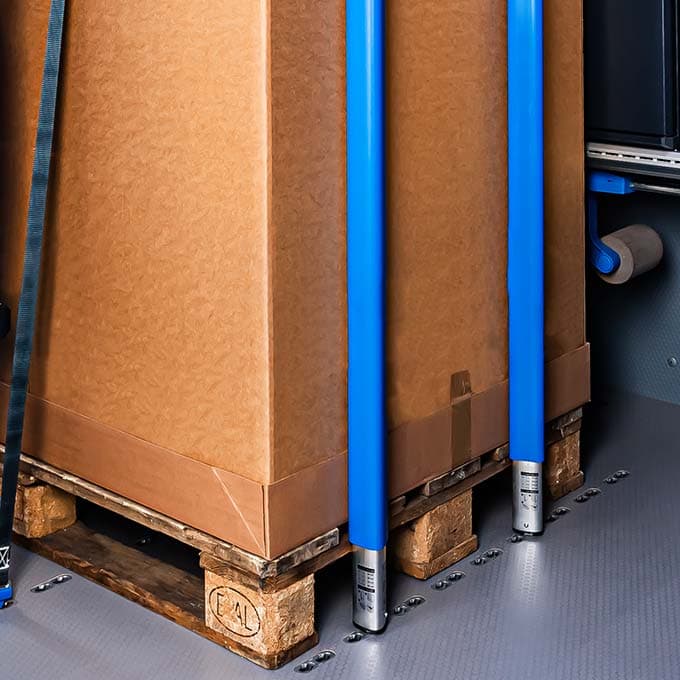

How it can look
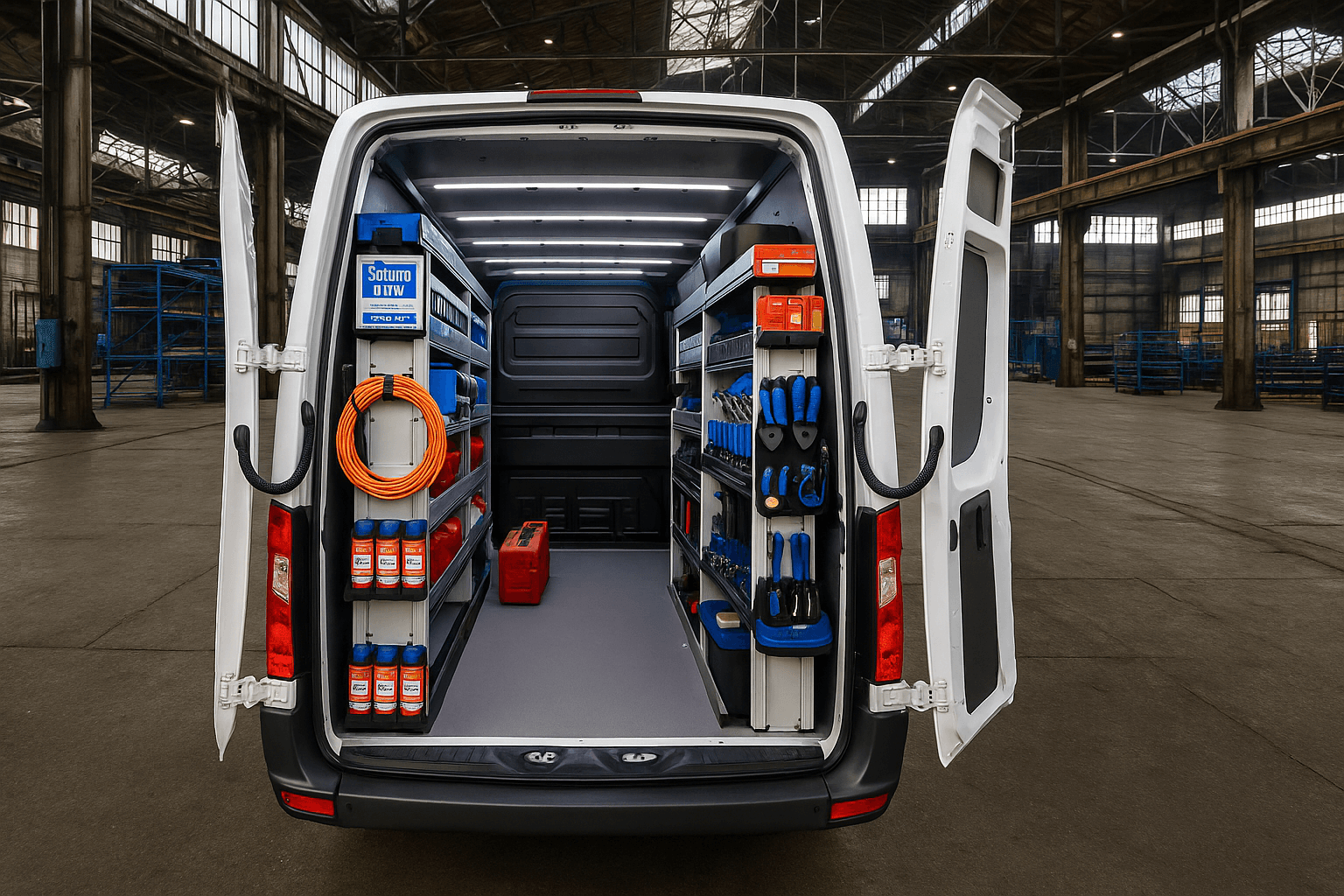
Typical build: courier vehicle with flexible securing
Walls
Lightweight load space cladding with integrated airline rails on three levels.
Securing
Blocking bars and nets for form-fit securing in seconds — for any parcel size, without rebuilding.
Floor
Non-slip floor, optionally with additional lashing points for special transports.
Workplace
Optionally a compact shelf module keeping scanner, film and documents within reach at the sliding door.
We fit out fleets in series — with fixed contact people, plannable dates and identical quality from the first to the fiftieth vehicle.
By company size
Which setup suits your business?
Single vehicle or subcontractor
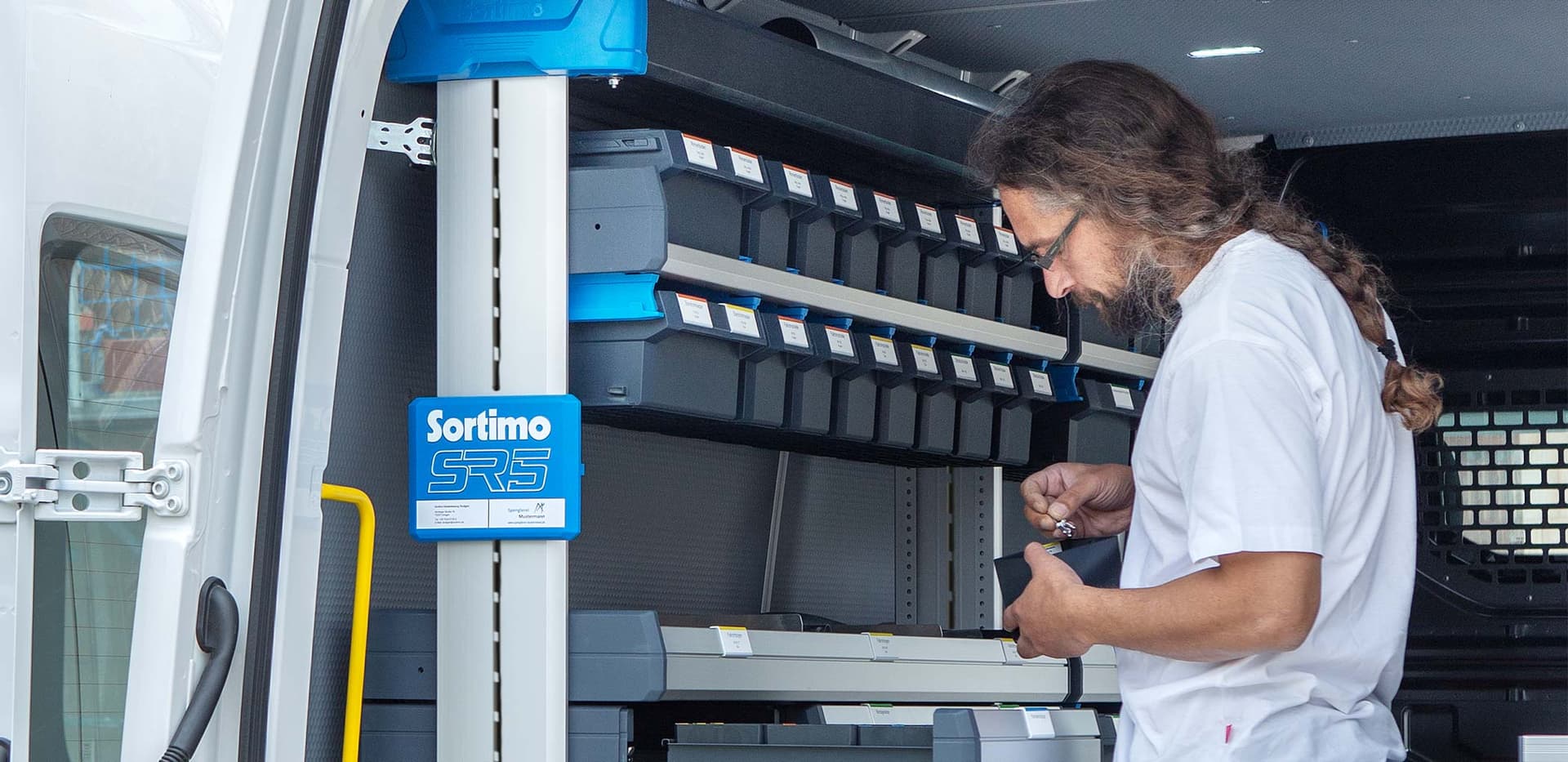
Anyone running one vehicle needs payload and speed when securing above all. Lightweight load space cladding with integrated airline rails, one blocking bar and one net cover most rounds. Fixed shelving is only worth it for scanner, film and documents — and deliberately kept small.
Small fleet, 2 to 10 vehicles
From several vehicles onwards, standardisation matters: the same rail heights, the same blocking bars, the same nets in every vehicle. Drivers who switch vehicles at short notice then secure the load correctly without having to adjust. Spare parts and accessories also fit every vehicle.
Fleet of ten vehicles or more
For fleets we plan a documented standard and build in series — with fixed contacts and staggered dates, so that several vehicles are never off the road at once. The documented standard ensures vehicle 50 is equipped identically to vehicle 1, even months later.
Tools & material
What goes where
| Item | Where it goes |
|---|---|
| Parcels of varying size | Airline rails on three levels plus blocking bars and nets. The load is enclosed form-fit, whether it is one pallet or twenty small parcels. |
| Roll cages and mesh trolleys | Lashing points in the floor and blocking bars that fix the cage against the bulkhead or side wall. Non-slip surfacing stops it wandering under braking. |
| White goods and heavy single items | Form-fit against the bulkhead, lashing straps on the airline rails, edge protection under every strap. Tall items secured against tipping as well. |
| Scanner, documents, shipping film | A compact shelf module at the sliding door, within reach without a detour via the rear. Deliberately small, so the load bed is preserved. |
| Several rounds in the same load space | Blocking bars as zone dividers, one zone per round. That shortens search time at every stop and noticeably reduces misdeliveries. |
| Vehicle walls and load sill | Lightweight wall cladding and a non-slip floor panel absorb impacts. On lease return that is regularly cheaper than repairing the bodywork. |
| Cab and driver protection | A bulkhead or dividing grid behind the seat row. With a high load that is effectively basic equipment, not an accessory. |
| Small consignments and letter post | Lightweight shelves or stackable containers on one side, secured via a rail. The rest of the load space stays freely configurable. |
| Chilled and temperature-controlled goods | A separated area with secured insulated containers and dedicated lashing points. Access should be possible without moving the rest of the load. |
From practice
Typical planning mistakes
Heavy shelving in a courier vehicle
Every kilo of racking comes straight off the payload and therefore off the number of parcels per round. In courier work a classic shelving build is almost always the wrong answer — lightweight cladding with rails does more at lower weight.
Rails at the wrong height
Airline rails only help where the load actually ends up in everyday use. Fitting them without looking at the real loading pattern gives you securing on paper but not in practice. We look at how your vehicles are actually loaded before planning.
Securing that takes too long
Anything that takes longer than a few seconds between two stops gets left out in everyday work. Blocking bars and nets work because they sit right without tools and without thinking — that is their real advantage over more elaborate systems.
Losing load space height to add-ons
Surface-mounted rails and thick cladding cost usable contour. Rails integrated into the cladding preserve the height almost completely — with tall consignments that decides how much can be carried per round.
Vehicle choice
Suitable vehicles for this trade
High-roof crew van
Typical models
VW Caddy Cargo, Renault Kangoo, Citroën Berlingo, Ford Transit Connect
Suitability
For city couriers and express services with small consignments. Lightweight cladding and one rail level are enough; every extra kilo is particularly noticeable here.
Medium panel van
Typical models
VW Transporter, Ford Transit Custom, Mercedes Vito, Opel Vivaro
Suitability
A good compromise for mixed rounds. Rails on two to three levels, blocking bars for zone separation, a compact module at the sliding door.
Large panel van
Typical models
Mercedes Sprinter, VW Crafter, Fiat Ducato, Ford Transit
Suitability
The standard in parcel delivery. Standing height makes sorting in the load space easier, and three rail levels cover all common consignment sizes.
Electric van
Typical models
Ford E-Transit, Mercedes eSprinter, Renault Master E-Tech, MAN eTGE
Suitability
Increasingly the standard in city delivery. The battery costs considerable payload, which makes lightweight cladding with rails practically the only option here.
Further reading
Payload is the currency in courier work
In logistics a different calculation applies than in the trades. A trade vehicle is fitted out once and runs that way for years; a courier vehicle is reloaded every day, and every kilo of racking reduces the number of consignments that can come along. The racking counts towards the kerb weight and therefore comes straight off the payload.
That is why we consistently use lightweight construction for fleets: load space cladding with integrated airline rails instead of heavy shelf modules, non-slip floor panels instead of double floors, flexible securing instead of fixed compartments. Doing without storage is no restriction here — in courier work the load space is emptied daily anyway.
Where shelving still makes sense we keep it small: a narrow module at the sliding door for scanner, film and documents. Anything beyond that costs more payload than it brings in order.
Securing that works at the pace of the round
Load securing is a legal requirement under Section 22 of the German Road Traffic Regulations (StVO); VDI 2700 describes the recognised methods. In delivery work, though, what decides whether a load gets secured is not the theoretical quality of a system but the time it costs. Anything taking longer than a few seconds will inevitably be skipped over sixty stops a day.
That is precisely why airline rails with blocking bars and nets have become established. They enclose the load form-fit, work without tools and adapt to different parcel sizes without anything having to be rebuilt. What matters is the positioning: the rails have to sit where the load actually ends up in everyday use.
Roadside checks regularly examine securing towards the front — that is, against the bulkhead. A dividing grid or bulkhead behind the seat row is therefore less an accessory than basic equipment when the vehicle is heavily loaded.
A fleet standard means repeatability
For fleet operators the most important point is not the individual vehicle but reproducibility. A standard that looks different on the fiftieth vehicle than on the first causes training effort, spare part chaos and mistakes when securing. We therefore record the layout in writing and build every new vehicle to match — even months or years later.
Scheduling is just as important. A delivery vehicle that is off the road costs revenue. We therefore stagger installation dates so that only individual vehicles are ever unavailable, and for larger batches we plan fixed slots across several weeks. In leased and hired vehicles we bolt to the mounting points provided rather than gluing, so that removal at the end of the contract leaves little behind.
Frequently asked questions from Courier · Logistics · Fleets
Advice for Courier · Logistics · Fleets
Tell us about your vehicle and your working day — we will plan the conversion that suits your trade.
Also of interest